
The Invisible Spring: A Conceptual Guide to Electrostatic Potential
1. The Logic of Stored Effort: Why Work Doesn’t Vanish
In our study of mechanics (Class XI), we learned that energy is never truly lost when moving against a resistance; it is merely redistributed. When an external force performs work to move a body against a “conservative force”—such as a spring or gravity—that work is stored as potential energy.
In the world of electrostatics, the Coulomb force behaves exactly the same way. When we move a test charge q against the electric field of a source charge Q, we must apply an external force (F_{ext}) that is equal and opposite to the electric force (F_E). To ensure that every bit of our effort is stored as potential energy and not “wasted” on motion, we move the charge infinitesimally slowly at a constant speed. This lack of acceleration means the kinetic energy remains unchanged, allowing the work done to be fully accounted for as a change in potential energy.
Concept Spotlight: The “So What?” of Conservative Forces
The defining trait of a conservative force is the absolute recoverability of energy. Because the sum of kinetic and potential energy remains constant, any work “stored” while moving an object can be fully “retrieved” as motion the moment the external force is removed. Energy is never lost to the system; it is merely held in a state of readiness.
This principle of storing effort bridges the gap between the mechanical systems we can touch and the invisible electrical systems that power our world.
2. Mechanical Mirrors: Gravity, Springs, and Charges
The electrostatic force is not a standalone mystery; it is a “mechanical mirror” of the laws of gravity and elasticity. Both the gravitational force and the Coulomb force share a fundamental inverse-square dependence on distance. Whether you are lifting a weight or pushing two like-charges together, you are essentially “winding up” an invisible mechanism.
| Force Type | Mechanical Action | Potential Energy Storage |
| Gravitational | Lifting a mass against the Earth’s pull. | Stored as Gravitational Potential Energy (U). |
| Spring | Compressing a spring from its rest position. | Stored as Elastic Potential Energy (U). |
| Electrostatic | Moving a test charge q against the field of a source charge Q. | Stored as Electrostatic Potential Energy (U). |
If you can conceptualize the tension in the coils of a compressed spring, you can understand the hidden energy residing in an electric field.
3. The “Pathless” Journey: Why Direction Doesn’t Matter
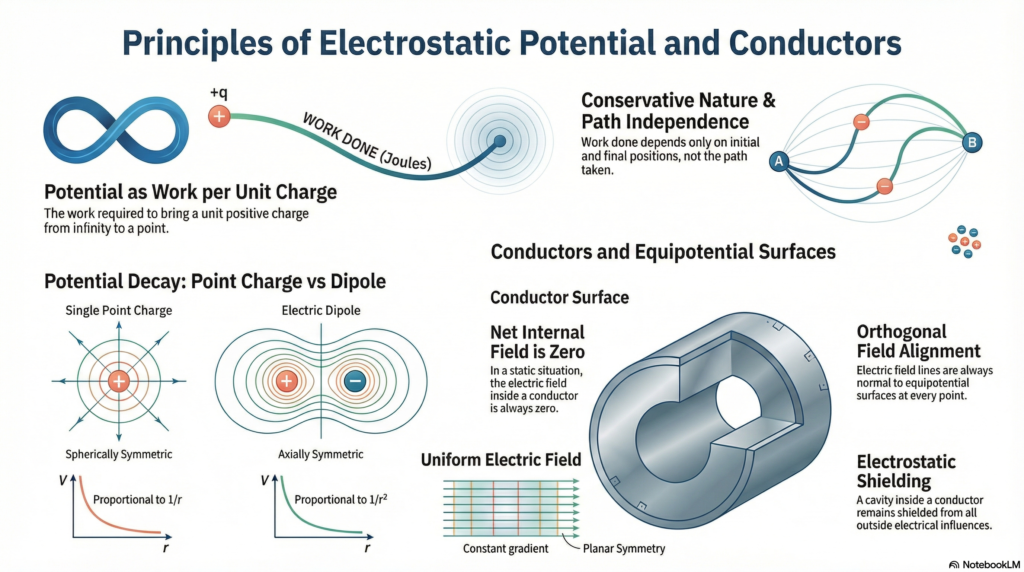
A remarkable property of conservative fields is that the “route” you take does not change the “price” you pay in energy. Whether you move a charge in a direct line or a chaotic zigzag from point R to point P, the work required remains identical.
This principle of path-independence is a fundamental characteristic of the electrostatic field—a fact mathematically rooted in Coulomb’s Law. Because the work depends solely on the initial and final positions, the concept of potential energy becomes a reliable way to label every coordinate in space with a specific energy value.
The work done by an electrostatic field in moving a charge depends only on its starting and ending points and is entirely independent of the path taken.
However, to turn this relative “difference” into a specific measurement for a single point, we require a universal starting point.
4. Defining the “Zero Point”: The Logic of Infinity
In physics, the absolute value of potential energy is less important than the difference between two points. However, to simplify our map of space, we use our “freedom of choice” to pick a reference point where the electric influence effectively vanishes.
The Case for Infinity
- Vanishing Influence: At an infinite distance (r = \infty), the force from a source charge Q drops to zero, making it the most natural “ground floor” for our energy scale.
- Simplifying the Math: By setting the potential energy at infinity to zero (U_\infty = 0), we trigger a vital mathematical transition. We move from measuring a difference, \Delta U = U_P – U_R (Equation 2.2), to defining the energy at a single point P as U_P = W_{\infty P} (Equation 2.3).
- The Absolute Map: This transition allows us to define the potential energy at any point P as the total work required to bring the charge q from the “zero-point” of infinity to that specific spot.
This shift allows us to move from the energy stored in a specific object to a general property of the space itself: Potential.
5. From Energy to Potential: The “Per Unit” Shift
While Potential Energy (U) depends on the specific test charge q you are moving, we often want to describe the “terrain” of the electric field itself, regardless of who is visiting. Since the work done is always proportional to the charge q (because F = qE), we can divide the work by q to find a value that is independent of the “guest” charge.
By dividing out the test charge, we move from the “influence of the guest” to the “nature of the house”—this resulting quantity is the Electrostatic Potential (V).
Definition: Electrostatic Potential (V)
The electrostatic potential at any point in a region is the work done by an external force in bringing a unit positive charge (infinitesimally slowly and without acceleration) from infinity to that point.
6. Visualizing the Field: Points and Surfaces
We can visualize the relationship between Potential (V) and the Electric Field (E) by looking at how they “decay” over distance. For a point charge, the potential decreases as 1/r, while the field strength drops much faster at 1/r^2. On a graph, the curve for potential appears “flatter” than the steep drop-off of the field.
We further visualize this through Equipotential Surfaces—regions where the potential remains constant.
- Point Charges: For a single charge, these surfaces are concentric spheres centered on the charge.
- Uniform Fields: In a uniform electric field, these surfaces are planes perpendicular to the field lines.
Learner’s Insight
- The Direction of Decay: The Electric Field (E) always points in the direction where the potential (V) decreases most sharply.
- The Perpendicular Rule: The Electric Field must always be normal (perpendicular) to an equipotential surface. If a tangential component existed, you would have to do work to move a charge along the surface, which would violate the definition of “equal potential.”
The equipotential surfaces serve as the “coils” of our invisible spring, mapping exactly where energy is stored in space.
7. Summary Synthesis: The Learner’s Map
Electrostatic potential is the ultimate map of “stored effort.” It tells us how much energy is available at any point in space to move a unit of charge.
3 Grok-able Insights:
- Energy as a Coordinate: Just as a book gains potential energy based on its height in a gravitational field, a charge possesses energy based strictly on its position in an electric field.
- The Path is Irrelevant: In the conservative “landscape” of electrostatics, the energy required to move between two points is constant, regardless of the route taken.
- Potential is the Field’s Signature: While potential energy (U) describes the charge, potential (V) describes the space. It is a fundamental characteristic of the electric field that exists even when no test charge is there to feel it.
Electrostatic Concepts, Formulations and Definitions
| Physical Concept | Symbol | Defining Formula | SI Unit | Dimensions | Key Characteristics | Source |
|---|---|---|---|---|---|---|
| Electrostatic Potential | V | V=W/q | Volt (V) | [M1L2T−3A−1] | Work done per unit charge in bringing a charge from infinity to a point; physically significant as a difference between two points. | [1] |
| Electrostatic Potential Energy | U | U=qV | Joule (J) | Not in source | Work required to be done by an external force to assemble a charge configuration; independent of the path taken. | [1] |
| Capacitance | C | C=Q/V | Farad (F) | [M−1L−2T4A2] | Depends only on the geometric configuration (shape, size, separation) and the nature of the insulator between conductors. | [1] |
| Dielectric Constant | K | K=C/C0 | Dimensionless | Dimensionless | The factor by which capacitance increases when a dielectric is inserted fully between the plates. | [1] |
| Polarisation | P | P=p/Δv | Cm−2 | [L−2TA] | Defined as the dipole moment per unit volume of a dielectric material. | [1] |
| Electric Dipole Moment | p | p=q⋅2a | Cm | Not in source | Points in the direction from −q to q; characterises the separation of two equal and opposite charges. | [1] |