
The Cricket Pitch Physics Lab: Understanding Distance and Displacement
Consider using this if you need to provide more context on why you do what you do. Be engaging. Focus on delivering value to your visitors.
Featured Image
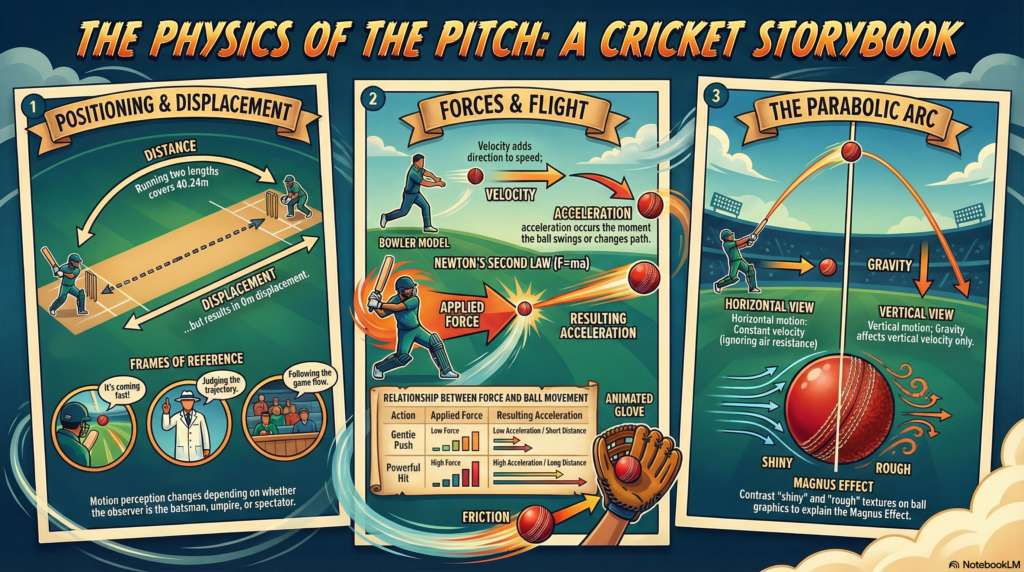
The Cricket Pitch Physics Lab: Understanding Distance and Displacement
1. Welcome to the Pitch: A New Way to Look at Motion
Welcome to “The Ultimate Physics Lab.” To the casual observer, a cricket field is a place of sport; to a physicist, it is a precision-engineered playground designed to demonstrate the fundamental laws of motion. Before we can measure how fast a ball is bowled or how far a batsman runs, we must establish our Frame of Reference—the specific perspective from which we observe and measure movement.
On a cricket field, your understanding of motion shifts depending on where you stand:
- The Batsman: Positioned at the crease, the batsman perceives the bowler’s movement as a frontal approach, where velocity is sensed as an immediate, looming urgency directed toward them.
- The Umpire: Standing behind the wickets, the umpire views the delivery as a lateral crossing, a perspective that allows them to judge the ball’s trajectory and height relative to the stumps.
- The Spectator: High in the stands, the spectator sees the movement of players and the ball as broad changes in position against the static backdrop of the entire field.
By recognizing that motion is relative to the observer’s position, we can transition from simply watching the game to calculating the precise path an athlete takes across the grass.
——————————————————————————–
2. Defining the Path: What is Distance?
In physics, every step a player takes contributes to a value called Distance. Using the visual model of a cricket pitch, imagine a batsman at the striking crease who hits the ball and runs toward the non-striker’s crease to complete a “Single Run.”
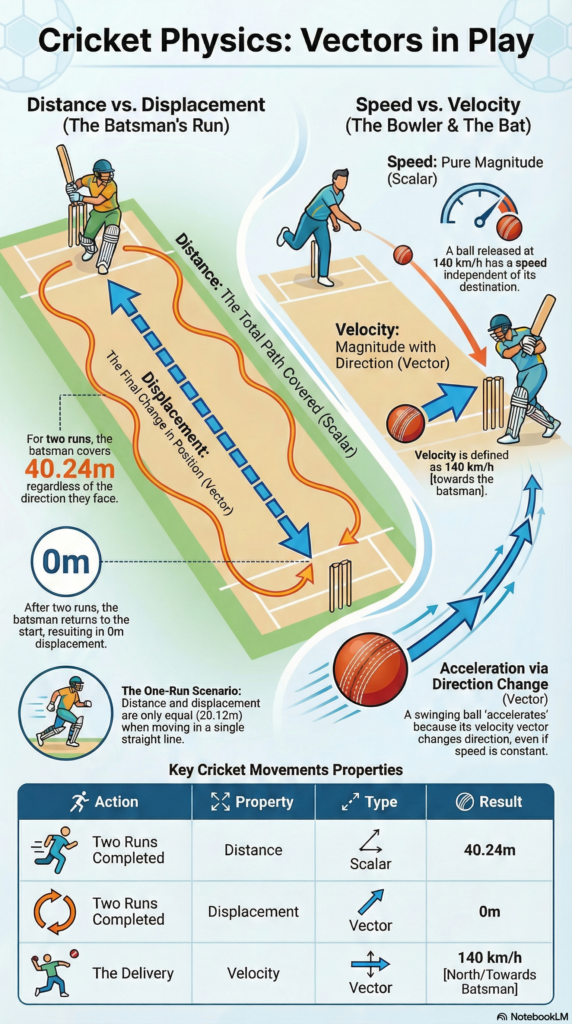
As the batsman moves, imagine a vibrant green line tracing their exact path along the pitch. By the time they reach the opposite crease, they have covered a distance of 20.12 meters. If they swerve or zig-zag to avoid a fielder, that green line would grow even longer.
Key Insight: Distance is a Scalar quantity. It represents the “odometer” reading of a journey—the total ground covered regardless of the direction taken.
While the total path tells us about the effort expended, it does not tell us the final result of the movement. For that, we need a different metric.
——————————————————————————–
3. Defining the Change: What is Displacement?
While distance tracks the entire journey, Displacement is a Vector quantity that focuses exclusively on the “gap” between where you started and where you ended. It is a straight-line measurement that requires both a magnitude (how far) and a direction.
In our “Single Run” scenario, the batsman moves from Point A (striking crease) to Point B (non-striker’s crease). Because this is a straight-line sprint of one length, the displacement is also 20.12 meters.
Displacement doesn’t care about the beauty, the swerves, or the struggle of the journey; it only cares about the final change in position from the starting point to the finish line.
But what happens when the journey ends exactly where it began? The answer lies in a mathematical “reset” that defines the core of displacement.
——————————————————————————–
4. The Great Reveal: How 40.24 Meters Becomes Zero
The distinction between these two concepts becomes startlingly clear when a batsman runs a “Double” (two runs). In this scenario, the batsman sprints to the opposite crease and immediately turns back to return to their original starting position.
As they run, the green line continues to trace their path, growing longer with every stride. However, look at what happens to the data:
| Metric | Single Run (1 Length) | Double Run (Round Trip) |
| Total Distance | 20.12m | 40.24m |
| Final Displacement | 20.12m | 0m |
Here is the “magic” of physics: When the batsman completes the second run, their Total Distance has doubled to 40.24 meters because they physically covered that amount of ground. However, because they ended exactly where they started, their Final Displacement triggers a “zero icon” on our tracking map.
Because there is no change in their final position relative to their starting point, their displacement is 0 meters. They worked twice as hard, yet according to the displacement vector, it’s as if they never moved at all! This realization is your first step in mastering the mechanics of the physical world.
——————————————————————————–
5. Summary of Insights: Navigating the Field
You have now navigated the essential building blocks of motion. As you prepare for more complex physics challenges, keep these three takeaways in your toolkit:
- Distance is a Scalar (The Odometer): It measures the total length of the path traveled. In our lab, this was the 40.24 meters of the round trip.
- Displacement is a Vector (The Map): It measures the straight-line distance and direction from start to finish. If you return to the start, displacement is always 0 meters.
- Direction is the Deciding Factor: For displacement, moving “backwards” subtracts from your “forward” progress, whereas distance only ever increases.
The next time you watch a match, remember: you aren’t just watching a game—you are watching a masterclass in physics. Every sprint and turn on that pitch is a living demonstration of how we measure the universe.
The Ultimate Physics Lab: A Visual Guide to Cricket Mechanics
1. Introduction: The Field as a Laboratory
Welcome to the ultimate physics laboratory. While it may look like a simple strip of grass, a cricket pitch is a high-precision environment where the fundamental laws of motion are tested in every over. To analyze these movements, we must first establish our Frames of Reference—the specific viewpoints from which we observe the “story” of the ball. Depending on where you stand, the physics of the game reveals different secrets:
- The Batsman’s View (The Crease): A front-on perspective where the bowler is a looming force accelerating toward you. Here, the ball’s motion is a high-stakes calculation of timing and reaction.
- The Umpire’s View (The Side Profile): Crucially, the physicist’s most valuable view is the side-on trajectory. This profile allows for the precise observation of the ball’s arc and path relative to the stumps.
- The Spectator’s View (The Stands): A wide-angle, bird’s-eye perspective where the entire field becomes a stage, making it easy to track the ball’s full parabolic journey and the collective movement of fielders.
Before we can track the path of a fast bowler, we must first understand how we measure simple movement on the ground.
——————————————————————————–
2. Distance vs. Displacement: The Runner’s Path
In mechanics, there is a vital distinction between how far an object travels and where it eventually stops. We visualize this using the standard 20.12-meter length of a cricket pitch.
| Measurement | Scenario: One Run (Single) | Scenario: Two Runs (Double) |
| Distance | 20.12 meters | 40.24 meters |
| Displacement | 20.12 meters | 0 meters |
| Physical Meaning | The total path covered by the batsman. | The change in position from the starting point. |
The “So What?” Insight: When a batsman runs a “two,” they exert the physical effort required to cover over 40 meters. However, because they return to their original starting crease, their displacement is zero. In physics, displacement only cares about the gap between the start and finish lines, regardless of the effort exerted in between.
Now that we can measure the path on the ground, let’s look at how we visualize the ball’s movement through the air.
——————————————————————————–
3. Velocity and the Power of the Vector Arrow
While “speed” tells us a ball is moving at 140 km/h, velocity provides the full picture by including direction. We visualize this using Vector Arrows:
- The Arrow Length: Represents the magnitude (speed). A longer arrow indicates a faster delivery.
- The Arrow Point: Indicates the direction of motion.
When a ball “swings” (curves in the air), the velocity vector arrow is constantly changing its pointing direction. Even if the speedometer stays at a constant 140 km/h, the ball is accelerating. This is caused by an inward-pointing acceleration vector that pulls the ball away from a straight line.
Acceleration isn’t just “speeding up.” Because velocity is a vector, changing the ball’s direction—even at a constant speed—requires acceleration. During the moment of bat-ball contact, we see instantaneous acceleration: the incoming velocity vector is instantly replaced by a new, outgoing vector pointing in a completely different direction.
Understanding velocity allows us to see the “why” behind the sudden changes when a bat meets a ball.
——————————————————————————–
4. Newton’s Laws: The Rules of the Game
Sir Isaac Newton’s laws of motion are the “invisible umpires” governing every interaction on the field.
- Law 1: Inertia A ball resting on the grass will remain stationary forever unless an external force acts upon it. That force is provided by the bowler picking it up, breaking the ball’s state of inertia to begin the over.
- Law 2: Force = Mass × Acceleration (F=ma) The acceleration of the ball is directly proportional to the force applied by the bat:
- The Gentle Push: A small force vector (low F) results in a small acceleration vector (low a). The ball trickles slowly toward a fielder.
- The Powerful Hit: A large force vector (high F) from a full swing results in a massive acceleration vector (high a). The ball rockets toward the boundary.
- Law 3: Action and Reaction For every action, there is an equal and opposite reaction. At the moment of impact, the “Force on Ball” vector sends the ball forward. Simultaneously, an equal “Force on Bat” vector pushes back into the wood. This is the physical cause of the “shudder” a batsman feels vibrating through the handle.
These laws govern the hit, but once the ball leaves the bat, it enters the world of projectile motion.
——————————————————————————–
5. The Parabolic Journey: Tracking a “Six”
When a ball is hit over the boundary, it follows a curved path known as a parabolic arc. To understand this, we use a “split-screen” mental model to visualize the horizontal and vertical forces acting simultaneously:
- Horizontal View: The horizontal velocity vector remains a constant length throughout the flight. Assuming negligible air resistance, no horizontal force exists to slow the ball down.
- Vertical View: This is a story of gravity. As the ball rises, the vertical velocity vector shrinks to a tiny point at the peak. As the ball falls, this vector grows longer again.
- The Constant Factor: Throughout this entire journey, the downward-pointing gravity vector (g) remains constant and unchanging, eventually pulling the ball back to earth.
While gravity pulls the ball down, other invisible forces work to make it curve and slow.
——————————————————————————–
6. Invisible Influencers: Friction and the Magnus Effect
Not all forces are as obvious as a bat’s impact. Some “invisible influencers” are found in the air and on the grass.
On the Ground: Friction
When a ball rolls across the outfield, it experiences Negative Acceleration (Deceleration). Here, a “Friction Force” vector points in the exact opposite direction of the ball’s motion. Deceleration is simply acceleration working against the direction of travel, “eating away” at the velocity vector until the ball stops.
In the Air: The Art of the Spin
Bowlers manipulate the air using the Magnus Effect. By polishing one side of the ball to be shiny while leaving the other side rough, they create contrasting air currents:
- Rough Side: Air becomes “turbulent” and chaotic as it passes over the surface.
- Shiny Side: Air flows “smoothly” and follows the curve of the ball.
This difference in airflow creates a Magnus Force vector that pushes the ball toward the side with lower pressure, causing the ball’s trajectory to “swing” mid-air and deceive the batsman.
——————————————————————————–
7. Conclusion: Seeing the Science
By visualizing the field through vectors and laws, a cricket match transforms from a mere game into a visual symphony of physical forces.
The 3 Most Critical Takeaways
- Vectors Tell the Truth: The length and direction of a vector arrow explain both the speed of a 140 km/h delivery and the complexity of a curving swing.
- Newton Defines the Power: Every boundary is a demonstration of F=ma, and every “shudder” in the handle is the “Force on Bat” vector reacting to the “Force on Ball.”
- Invisible Forces Rule the Result: From the constant pull of the gravity vector (g) on a six to the turbulent air currents creating the Magnus Effect, the laws of physics are the final judge of every play.
Data Table
Slide Show
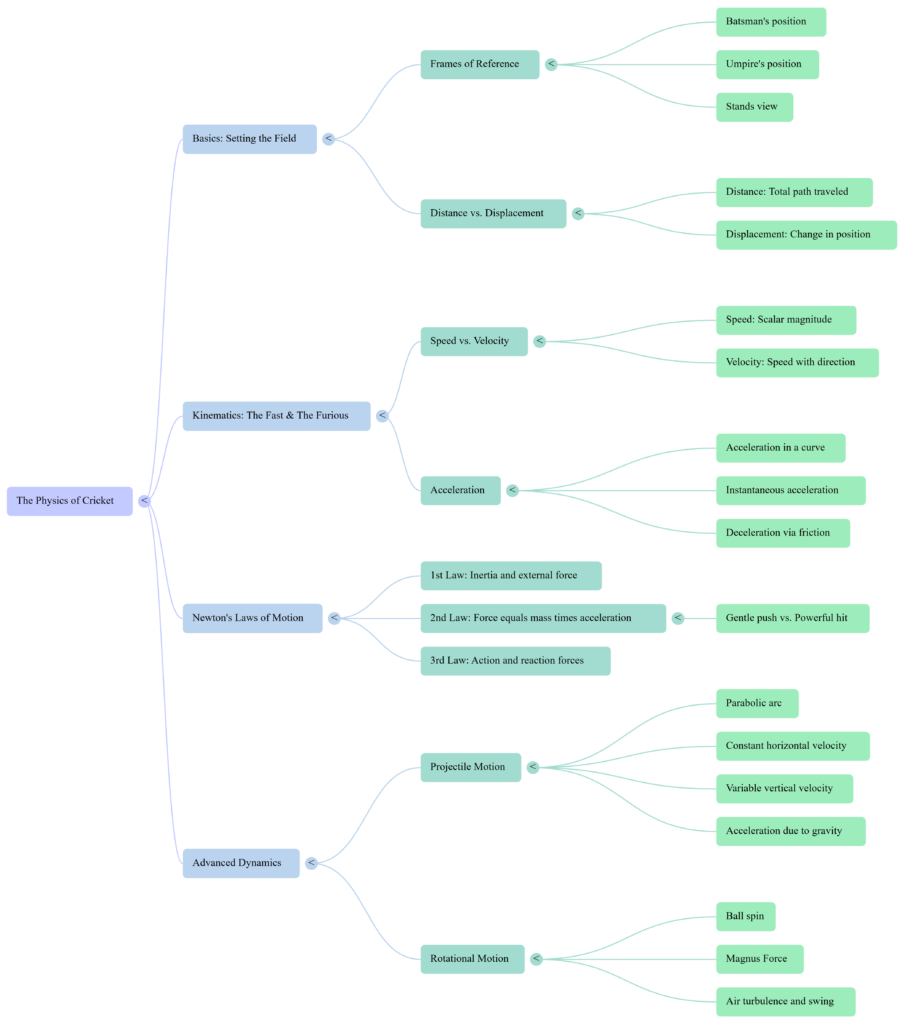
Create an encouraging guide for new learners that simplifies the concepts of motion. Using the specific scenario of a batsman running between the wickets, explain why the total path covered is different from the final change in position. Use a friendly tone to help the student understand why running two full lengths of the pitch results in a displacement of zero, making these abstract concepts feel intuitive and easy to grasp.
Produce a formal technical brief that defines the scientific parameters for every animation sequence outlined in the script. The core objective is to ensure that the visual assets—ranging from the vector arrows on a swinging ball to the parabolic arcs of a six—maintain absolute physical accuracy. This document must specify the required behaviours for variables like the Magnus force, friction vectors, and gravitational acceleration, providing animators with a clear set of scientific constraints to ensure the final product serves as a valid instructional model.
Generate a beginner-friendly explanation of Newton’s Laws and projectile motion through the lens of cricket. Focus on describing how invisible forces, such as gravity and friction, influence the ball’s movement through the air and across the grass. Help the student ‘see’ the physics by explaining the purpose of vector arrows in showing direction and speed, turning the complex math of a cricket shot into a clear, story-driven explanation of movement.
Abhidnya Bowling Calculator
The Physics of the Pitch | STEM Wing
ALERTS Categorization: The script automatically calculates if the ball is a “Good Length” or a “Bouncer,” turning a simple calculation into a tactical lesson for your students.
The Science: It uses the real Parabolic Trajectory Equation. If a student asks why the ball travels further at a higher speed, you can show them the $u^2$ in the formula.
Visual Trust: The creases are marked exactly 20.12 meters (22 yards) apart, honoring the dimensions of the game.
The ALERTS Lab Note: The Kinematics of the Pitch
While it looks like a simple animation, this calculator is solving the Projectile Motion Equation in real-time. Every time you move the slider, you are altering the variables of a classic physics problem.
1. The Velocity Factor (u2)
Notice that when you increase the speed, the ball doesn’t just go faster; the landing point shifts significantly further. In the trajectory equation, velocity is squared (u2) in the denominator of the gravity term. This means a small increase in bowling speed has a disproportionately large impact on where the ball pitches.
2. The Release Angle (theta)
The “Release Angle” determines the initial vertical component of the ball’s flight.
- Negative Angles: Result in “skidders” or Yorker-length deliveries.
- Positive Angles: Create the “loop” or “arc” seen in spin bowling or bouncers.Even a change of 1.0° can be the difference between a “Good Length” and a “Full Toss.” This is the precision required by the Human Algorithm of a professional bowler.
3. The Constant of Gravity (g)
No matter how fast you bowl, gravity pulls the ball toward the pitch at a constant rate of 9.81 m/s2. The calculator accounts for this downward acceleration, which creates the parabolic curve you see on the canvas.
The “Whole-Brain” Takeaway
In our STEM wing, we use this widget to show that Tactical Wisdom is actually Applied Physics. A captain who understands these variables isn’t just playing a game; they are managing a high-velocity system.